

Downtown Cleveland is a neighborhood. Treat it like one.
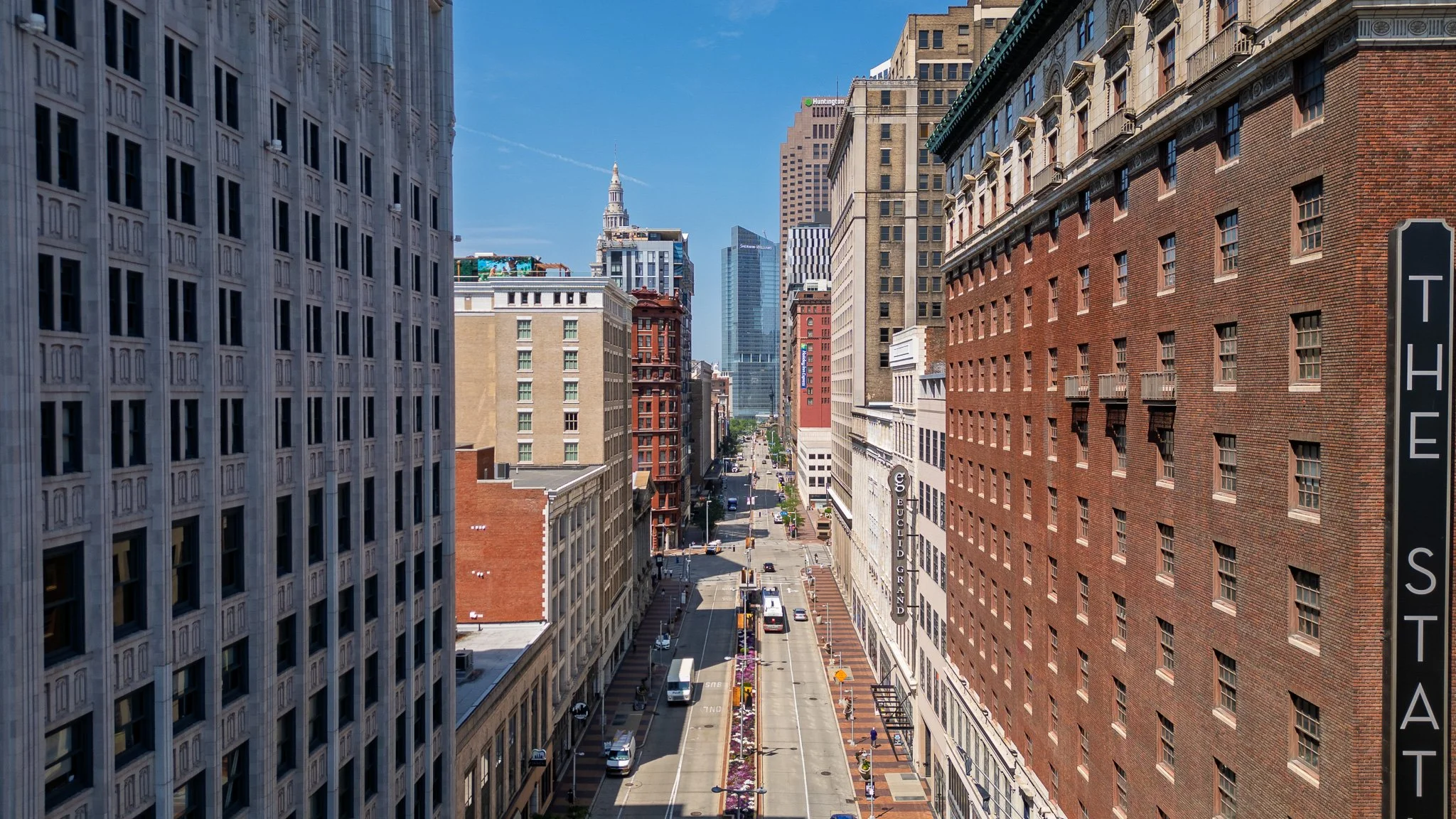
A stronger Cleveland starts by recognizing Downtown as part of the city’s neighborhood fabric
.
In Cleveland, nearly every conversation about development and public investment eventually finds its way to the same battlefield: Downtown vs. the neighborhoods. It is often passionate, and at times, it is necessary.
But too often, it begins from a false premise.
Downtown Cleveland, just like Ohio City, Hough, Collinwood, Fairfax, Detroit-Shoreway, Slavic Village, West Park, Glenville, Old Brooklyn, and so many others, is a neighborhood.
It is time we treated it as such.
The contours of the debate are well established. One side says Downtown consumes too much attention, too much money, and too much political urgency. The other says Downtown is the region’s front door, economic engine, visitor hub, employment center, and civic gathering place.
Both arguments contain truth.
Downtown does receive a disproportionate share of attention. It is where physical development is most visible, where skyline renderings are most seductive, and where sports teams, developers, major institutions, and civic leaders most often collide. It is also undeniably important to the city and region. A hollowed-out, underperforming Downtown would be bad for Cleveland, bad for the tax base, bad for tourism, bad for transit, bad for employers, and bad for civic confidence.
But too often, both sides of the argument make the same mistake, and Downtown is discussed as an abstraction: a skyline, an office market, an events district, a tourist destination, or a playground for the young, wealthy, transient—and often white—elite.
That image is incomplete. In many ways, it is wrong.
Downtown is a place people call home.
Depending on the boundary used, thousands of Clevelanders live in the core. 2024 Census estimates show nearly 17,000 residents, while Downtown Cleveland, Inc. counts roughly 21,000. Whatever number you use, the point is the same: Downtown is not merely a place people visit, work in, or drive through. It is a place where people live out their lives.
And those people are not all the same.
Downtown is young, yes. But it is also far more racially, ethnically, and economically diverse than the stereotype suggests. Roughly 51% of residents are white. More than 28% are Black, about 12% are Asian, nearly 6% identify with two or more races, and just over 5% are Hispanic or Latino. More than one in five residents over age 5 speaks a language other than English at home, and nearly 17% are foreign-born.
The economic picture is just as complicated. Nearly one-third of residents live below the federal poverty threshold, and more than four in 10 live in or near poverty. Nearly 30% of Downtown households earn less than $25,000 a year. At the same time, more than 8% earn more than $200,000.
That is not a monolith. It is not simply a place people pass through on the way to work, dinner, a Browns game, or a concert. It is home.
Too often, Cleveland talks about Downtown as if it exists primarily for people who do not live there. And that caricature shapes the politics.
When Downtown is reduced to luxury apartments, cocktails, stadium parking, and shiny office towers, it becomes easier to dismiss the people who actually live there. It becomes easier to talk about Downtown investment as if it only benefits developers, visitors, commuters, and a narrow slice of affluent residents. It becomes easier to treat Downtown as a place where everyone has an opinion, but where the people who call it home somehow have less claim to their own neighborhood than residents elsewhere in Cleveland.
I am now going into my 11th year living Downtown, and the gap between the stereotype and the reality is impossible not to notice.
My building, like several others Downtown, is not one thing for one kind of person. It includes luxury, market-rate, and income-restricted units, including some reserved for residents earning a percentage of Area Median Income (AMI). The result is a vertical neighborhood in the truest sense.
On any given day, I may share an elevator with professional athletes, Heinen’s cashiers, Cleveland Clinic employees, ballpark staff, service workers, students, retirees, and others from across the socioeconomic spectrum, all living at the same address.
That is not a theoretical talking point. It is the worker coming home from a hospital shift, the person heading to a restaurant job, the older resident waiting for a ride, the student with headphones on, the neighbor heading to the gym or to a second job.
That is what neighborhoods are. They are not slogans. They are the accumulated routines of the people who live there.
Across the street, visible from my window, is Winton Manor, a historic former hotel that has operated as affordable housing since 1971. Today, it contains 270 affordable units for seniors and residents with disabilities. Many have lived there for years. Similar properties, traditional public housing, workforce units, and homeless shelters, are part of Downtown’s fabric, too.
That does not mean Downtown is perfect or affordable enough.
It means the caricature is false.
It also means Downtown’s needs should be understood as neighborhood needs.
A neighborhood where more than a quarter of workers walk to work needs safe intersections, maintained sidewalks, shade, lighting, and pedestrian-first street design. Those are not aesthetic extras, but basic infrastructure.
A neighborhood where more than 95% of occupied homes are rented needs a serious conversation about tenant stability, affordability, building conditions, and long-term livability. It needs more than new units. It needs homes people can stay in and make their own.
A neighborhood with seniors, residents with disabilities, low-income renters, service workers, students, young professionals, empty nesters, and immigrants needs basic services. It needs grocery access, reliable transit, public restrooms, parks, benches, trees, trash cans, recreation, and places to gather that do not require buying something.
A neighborhood where the tree canopy covers just 4.2% of land area, compared with 17.8% citywide, needs trees not as decoration, but as public health infrastructure. The built environment is not an abstract planning category when it is the environment people live in every day.
This is where the “Downtown vs. the neighborhoods” frame becomes so limiting.
It asks us to choose between categories that should not be in opposition. It implies that Downtown is something outside the neighborhood system, something separate from Cleveland’s residential reality. It treats Downtown investment as inherently less neighborhood-focused because Downtown is also a regional asset.
But Downtown can be both.
It can be the region’s front door and a Cleveland neighborhood. It can contain major employers and apartment buildings. It can host concerts, games, conventions, protests, festivals, and parades, while also being the place where someone is trying to sleep before an early shift. It can be a civic gathering place and a place where residents want the crosswalk fixed, the sidewalk cleared, the streetlight repaired, the bus stop improved, and the vacant storefront filled.
Those identities are not contradictory.
In fact, the places we tend to admire most in other cities are precisely the places that manage to be both civic and residential. They are places where workers, tourists, residents, and institutions overlap. Places that are active at noon, at 6 p.m., and on a Tuesday morning in February, and that feel like part of the city, not a stage set for occasional events.
Cleveland should want that for its Downtown.
And yet, in our local debate, Downtown is often denied the same neighborhood respect we increasingly understand elsewhere.
People who would rightly object to outsiders dictating what is best for Hough, West Park, Collinwood, Glenville, or any other Cleveland neighborhood often feel free to speak about Downtown as if no one lives there. They reduce it to parking, stadiums, nightlife, visitors, developers, and subsidies.
We’ve stopped talking about Downtown as a community and started talking about it as infrastructure. We would never talk about most Cleveland neighborhoods that way.
To be clear, this is not an argument that only Downtown residents should have opinions about Downtown. Downtown is a shared civic space. It contains public assets, it receives outsize public investment, and it affects the regional economy. It belongs, in some real sense, to all Clevelanders.
And public dollars always deserve scrutiny.
Tax abatements, TIFs, subsidies, infrastructure spending, land deals, stadium proposals, and waterfront plans should be transparent, measurable, and tied to real public benefit. No neighborhood, Downtown included, should get a blank check. No developer should be handed public resources because a project looks good in a rendering, and no public investment should be defended merely because it is Downtown.
But scrutiny should not require erasure.
There is a difference between asking whether a public investment is fair, effective, and accountable, and speaking about an entire neighborhood as if its residents are props in someone else’s civic debate.
There is a difference between questioning a subsidy and dismissing the daily needs of thousands of Clevelanders.
There is a difference between saying, “This public deal needs a better return,” and saying, “Why are we spending money Downtown when we should be spending money in the neighborhoods?”
The second question is the problem. Because Downtown is one of those neighborhoods.
A better question would be: Does this investment make Downtown more livable for the people who live there, more useful to the people who work there, more accessible to the people who visit, and more beneficial to the city as a whole?
That is the standard we should use.
Not Downtown vs. the neighborhoods. Neighborhood benefit vs. private extraction. Public value vs. private subsidy. Accountability vs. assumption.
That distinction does matter because Downtown investment can absolutely fail the test. A project can be expensive, exclusionary, poorly designed, overly car-oriented, disconnected from transit, hostile to pedestrians, indifferent to affordability, or primarily beneficial to private interests. When that happens, it should be criticized.
But a street improvement that makes it safer for residents to walk to work is not merely a “Downtown project.” A park that gives residents a place to sit, gather, and breathe is not merely a “Downtown amenity.” A grocery store that serves apartment dwellers, seniors, workers, and visitors is not merely a luxury. A bus stop, crosswalk, public restroom, tree planting, lighting improvement, or sidewalk repair is not a gift to developers.
It is neighborhood infrastructure.
Downtown residents need the things any neighborhood needs: safety, groceries, parks, sidewalks, transit, trees, basic services, affordable housing, places to gather, and reasons to stay.
And they need to be heard in the conversations that shape those things.
That means public meetings about Downtown development should not treat residents as an afterthought, neighborhood-level concerns should not be dismissed as secondary to regional ambitions, quality of life should matter as much as tax increment projections, and that we should care whether a project makes Downtown better at street level, not just whether it photographs well from the air.
It also means recognizing that Downtown’s success cannot be measured only by cranes, visitors, hotel rooms, or office occupancy. Those things matter, but they are incomplete.
A healthier measure of Downtown success would ask different questions.
Are more people able to live Downtown at different income levels? Are long-time affordable housing residents protected as investment grows around them? Are sidewalks safer? Are storefronts occupied by businesses residents actually use? Is transit reliable? Are there places to sit without paying? Are public spaces maintained? Are streets designed for people walking, biking, riding transit, using wheelchairs, pushing strollers, and aging in place? Are residents able to build community, or are they merely leasing units near entertainment?
That is the difference between a district and a neighborhood.
A district can be programmed. A neighborhood has to be lived in.
Cleveland has spent decades trying to rebuild its core after the forces that hollowed out so many American downtowns: suburbanization, highway construction, population loss, office flight, retail decline, and the broader consequences of racial and economic disinvestment. We should not pretend that rebuilding Downtown is easy, or that it happens without public choices.
But we should also not pretend that Downtown’s revival is separate from Cleveland’s neighborhood story.
It is part of that story.
The same city that must invest in the Southeast Side, repair homes in Fairfax, stabilize housing in Slavic Village, support small businesses in Collinwood, improve transit access in Kinsman, and strengthen commercial corridors across Cleveland must also understand Downtown as a neighborhood where people live, struggle, work, age, rent, commute, vote, and build community.
This is not a call to privilege Downtown over other neighborhoods.
It is a call to stop excluding Downtown from the moral and civic framework we apply to neighborhoods.
If the principle is “listen to residents,” Downtown residents count. If the principle is “invest in neighborhoods,” Downtown is one.
If the principle is “public dollars should create public benefit,” that standard applies Downtown, too.
If the principle is “development should serve people, not just capital,” then the people who live Downtown must be part of the conversation.
Cleveland does not win by pitting its core against its neighborhoods. It wins by insisting that investment anywhere deliver neighborhood benefits. It wins by demanding public accountability everywhere. It wins by rejecting the idea that there are “real neighborhoods” and then there is Downtown.
A strong Downtown and strong neighborhoods are not competing visions. They are the same vision, properly understood.
Because the goal is not a Downtown that wins while other neighborhoods lose. And the goal is not neighborhoods that win by starving Downtown of the basic investments required to make it livable.
The goal is a Cleveland where every neighborhood, Downtown included, is stable, connected, walkable, and worthy of sustained investment. A city where growth is measured not only by cranes and ribbon cuttings, but by whether people can build lives and remain rooted in their communities.
So let’s retire the false choice.
The question should not be “Downtown or neighborhoods?” It should be: Are we making every Cleveland neighborhood, Downtown included, more livable, more inclusive, and more accountable to the people who call it home?