60 years later, Downtown Cleveland faces the same challenge
Few businesses symbolize Downtown Cleveland’s revival like Heinen’s.
When the hometown grocer opened in 2015, Downtown’s residential resurgence was uncertain. It transformed the historic Cleveland Trust rotunda into a grocery store unlike any in the country and became an early sign that Downtown could function as a neighborhood rather than simply a business district.
Its closure is symbolic and deeply practical. It marks the loss of one of Downtown’s earliest votes of confidence and leaves thousands of residents without a full-service grocery store in their neighborhood. For many, especially those without cars, the closure will make daily life more difficult and expose how few alternatives the neighborhood provides.
Those concerns shouldn’t be minimized, and neither should we mistake this moment for evidence of a new downward trend or a verdict on Downtown Cleveland’s future. It is stronger than the headlines imply, yet more fragile than the cranes suggest. The closure is the latest expression of a challenge that has defined Downtown for generations. Hybrid work and the pandemic intensified that weakness. They did not create it.
In 1959, city planners described lower Euclid Avenue as “a curiously constituted creature with a head at each end of a long, weak body.” Department stores on Public Square anchored one end, and those in Playhouse Square the other. Activity clustered around both, while the intervening stretch of Cleveland’s premier retail corridor lacked the continuous activity expected of a major downtown. Pedestrian surveys in the late 1950s found that only 8% of Downtown shoppers visited both Higbee’s and Halle’s, indicating almost no pedestrian interchange between the two hubs.
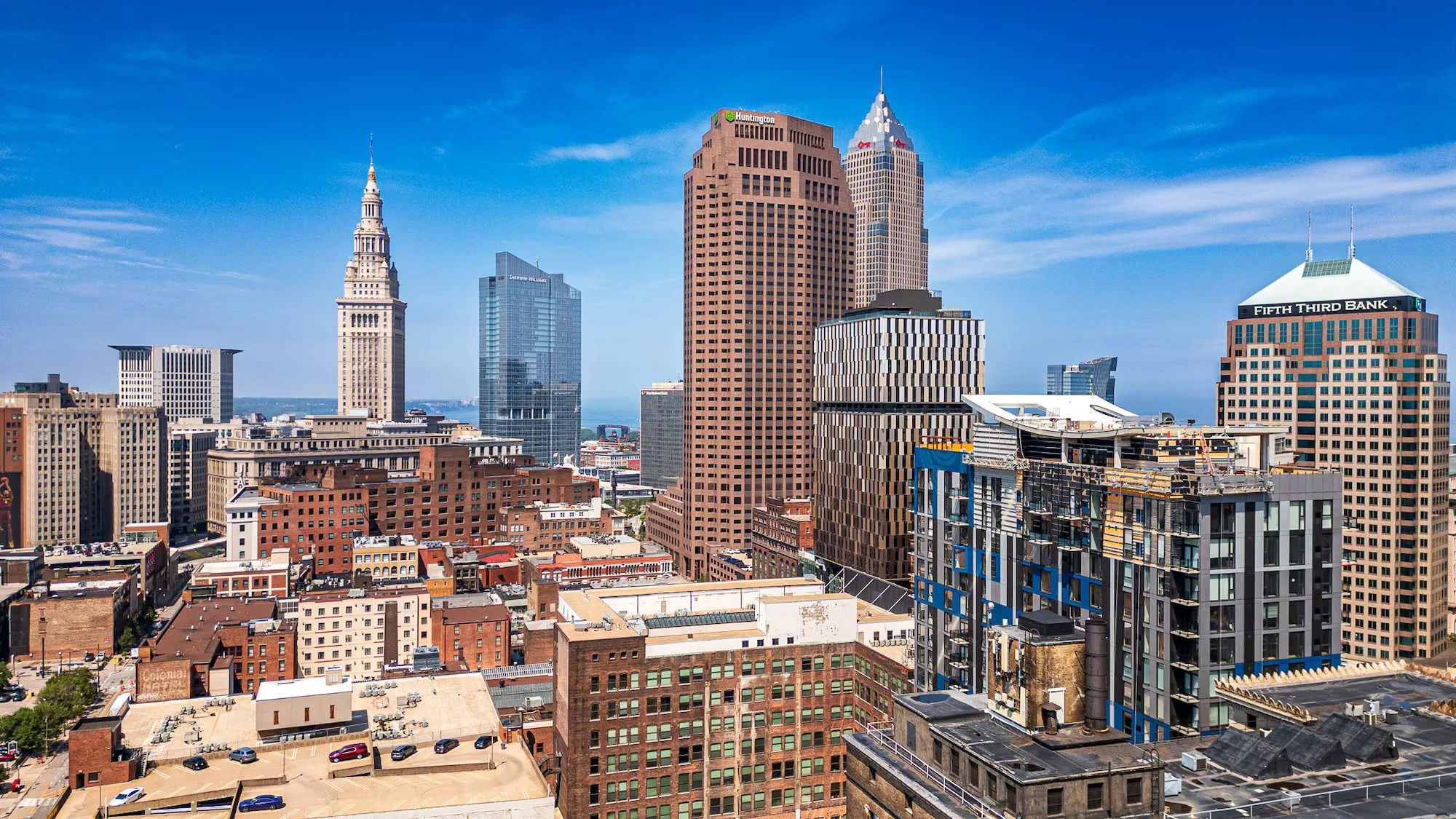
The same pattern still defines Downtown. Playhouse Square can feel like the center of a larger city before a show, East Fourth Street and Gateway fill before games and concerts, and the Warehouse District has matured into a residential neighborhood. But between those nodes, activity can fade within a few blocks, weakening the continuity needed to sustain neighborhood businesses.
Heinen’s occupied a place in that system. At East Ninth and Euclid, it sat near the middle of the same corridor planners worried about six decades ago. It was a destination, but it helped bridge Downtown’s most vibrant hubs. Its closure will weaken that middle.
The challenge now is creating continuous activity so Downtown’s destinations reinforce one another. Games, shows, conventions, offices, and residential life bring thousands of people into the city center, but street-level businesses depend on those populations overlapping throughout the day. Without that overlap, even successful destinations function like islands.
Cleveland’s planners have consistently recognized this. A 1957 report introduced the “concept of interdependence,” arguing that Downtown destinations could not thrive in isolation. They had to support one another by maintaining a continuous concentration of people throughout the day. The city’s 1983 civic vision returned to the same principle: successful downtowns aren’t built through isolated projects, but through coordinated investment over time.
That history explains why the Heinen’s closure and Downtown’s current development boom are not contradictory. The closure does not signal that Downtown’s investment wave is failing. It shows how much work remains to connect its districts and investments into a functioning whole.
Downtown has never seen this level of investment in my lifetime. We’re reshaping and reconnecting with our waterfronts, apartments continue to fill former office buildings, and new neighborhoods are emerging on long-vacant industrial land.
The transformation along the river represents billions in active and planned investment, much of it aimed at reconnecting the Cuyahoga with Downtown’s streets, public spaces, and surrounding neighborhoods. That emphasis on connection is the kind of thinking Downtown needs at scale.
Still, physical investment alone doesn’t create the everyday ecosystem that allows an urban neighborhood to function. Heinen’s closing brings Downtown’s unfinished work into focus: ensuring that major investments also support the stores, services, and daily activity the neighborhood requires.
That means treating grocery stores, small businesses, sidewalks, transit, public spaces, and housing as parts of the same system rather than separate concerns.
Downtown is where the region introduces itself to visitors, investors, prospective residents, and college graduates deciding where to build a life. Its strength depends on whether its districts, institutions, public spaces, and major destinations connect to one another and generate activity beyond the boundaries of any single project.
Every great region depends on a great Downtown, and ours does not lack ambition or investment. Its next chapter will depend on what happens between the megaprojects, and whether the heart of the city becomes as connected and complete as it is ambitious.