How Cleveland Is Rebuilding Its Riverfront
The rebirth of Cleveland's Flats is becoming a case study in post-industrial urban revitalization.
For generations, the Flats were the engine room of Cleveland's economy. Steel mills, shipyards, railroads, warehouses, and heavy industry lined the banks of the Cuyahoga River, powering the city's rise as one of America's great industrial centers. But as manufacturing declined in the second half of the twentieth century, much of that landscape was left fragmented by vacant land, obsolete infrastructure, environmental challenges, and scattershot development.
Thanks for reading! Subscribe for free to receive new posts and support my work.
The transformation along a short stretch of the Cuyahoga River in just the past few years has been remarkable. Projects that spent years, and in some cases decades, in the planning stages are finally taking shape, creating a level of momentum that would have been difficult to imagine not long ago.
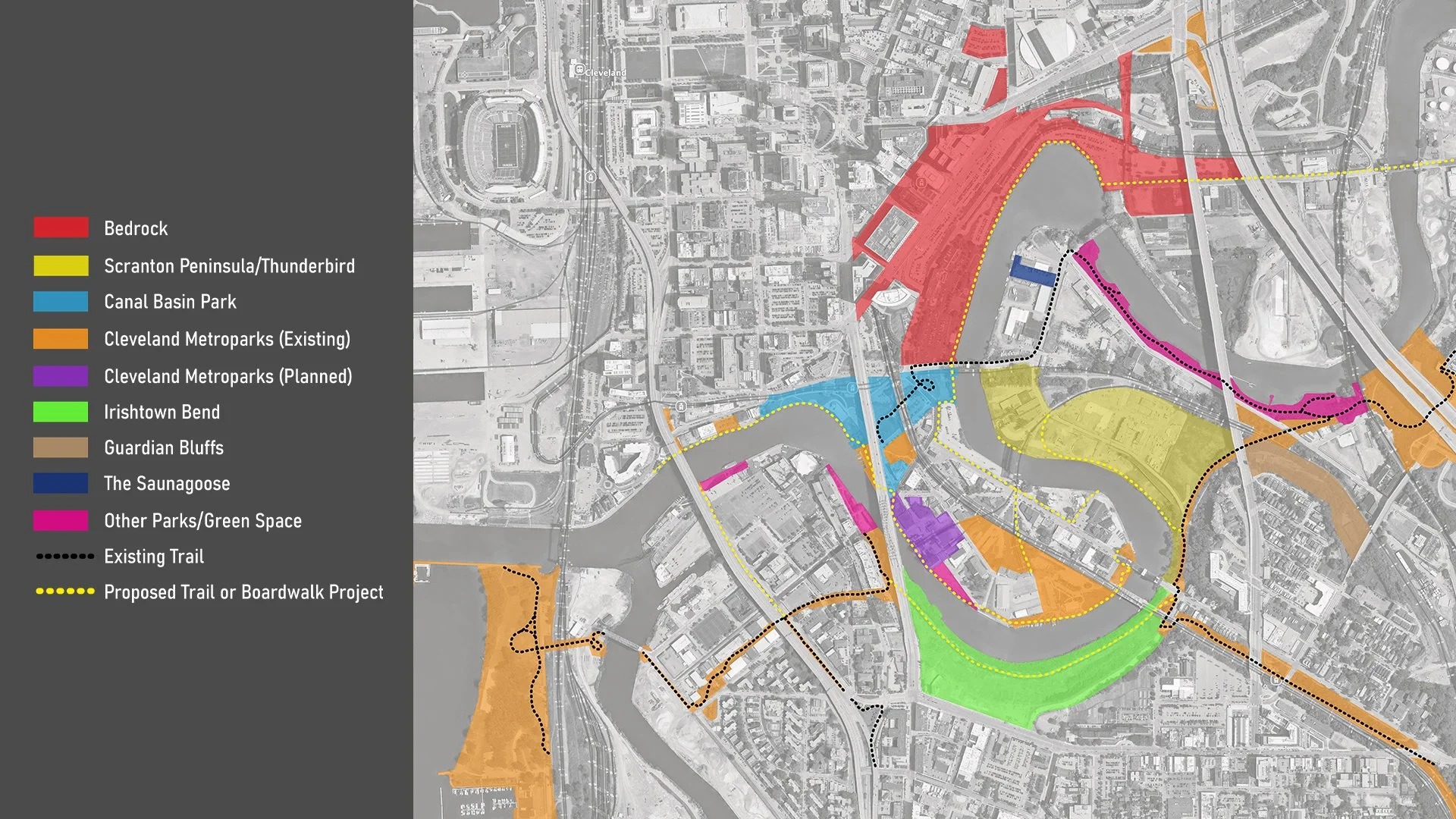
Projects recently completed, underway, or planned include:
The $63 million Grain Craft redevelopment and the broader Cleveland Metroparks public access improvements on the Columbus Road Peninsula, which will link planned and existing riverfront assets.
The 22-acre reimagining of Canal Basin Park.
Irishtown Bend Park, a 25-acre waterfront green space and a key connector to regional trail systems and the Cuyahoga Valley National Park.
Scranton Peninsula, where a new neighborhood of more than 600 apartments and townhomes has risen on the site of the former Republic Steel plant, with the potential for a future Great Lakes Brewing Company expansion.
The Saunagoose, a year-round sauna and cold plunge park coming to the Scranton Peninsula.
Bedrock’s $3.5 billion riverfront master plan, a cornerstone of Mayor Justin Bibb’s Shore-to-Core-to-Shore initiative, which will reimagine 35 acres of underutilized land and better connect Downtown Cleveland with both the Cuyahoga River and Lake Erie. The 3.5 million-square-foot plan includes 12 acres of publicly accessible riverfront space, including a riverwalk, plazas, trails, gathering spaces, and year-round waterfront programming. Its latest addition is a proposed 6,200-seat outdoor amphitheater.
The Cleveland Clinic Global Peak Performance Center, the first vertical development in Bedrock’s master plan, is a 210,000-square-foot state-of-the-art training facility that will become the new home and practice facility of the Cleveland Cavaliers.
Guardian Bluffs, the four-acre former site of Epic Steel adjacent to the Scranton Peninsula and the Towpath, now being marketed for multifamily development.
A transformation of this scale doesn’t happen because one developer arrives with a bold vision, one administration spends public dollars, or the market suddenly discovers overlooked land.
It happens when public investment, private development, and long-term planning reinforce one another. That’s how cities are built.
Too often, we think about urban development as a series of isolated wins and losses, judging projects individually instead of asking what they make possible. In reality, successful cities function more like ecosystems.
Each project creates value beyond its own property line. Housing makes retail more viable, parks make neighborhoods more desirable, public infrastructure reduces private risk, and trails connect destinations that would otherwise compete with one another.
That’s exactly what’s happening along the river today. In fact, Bedrock has fully embraced this mindset in their approach to development in Downtown Cleveland, which is evidenced in a project far from the banks of the Cuyahoga, but directly tied to its rebirth.
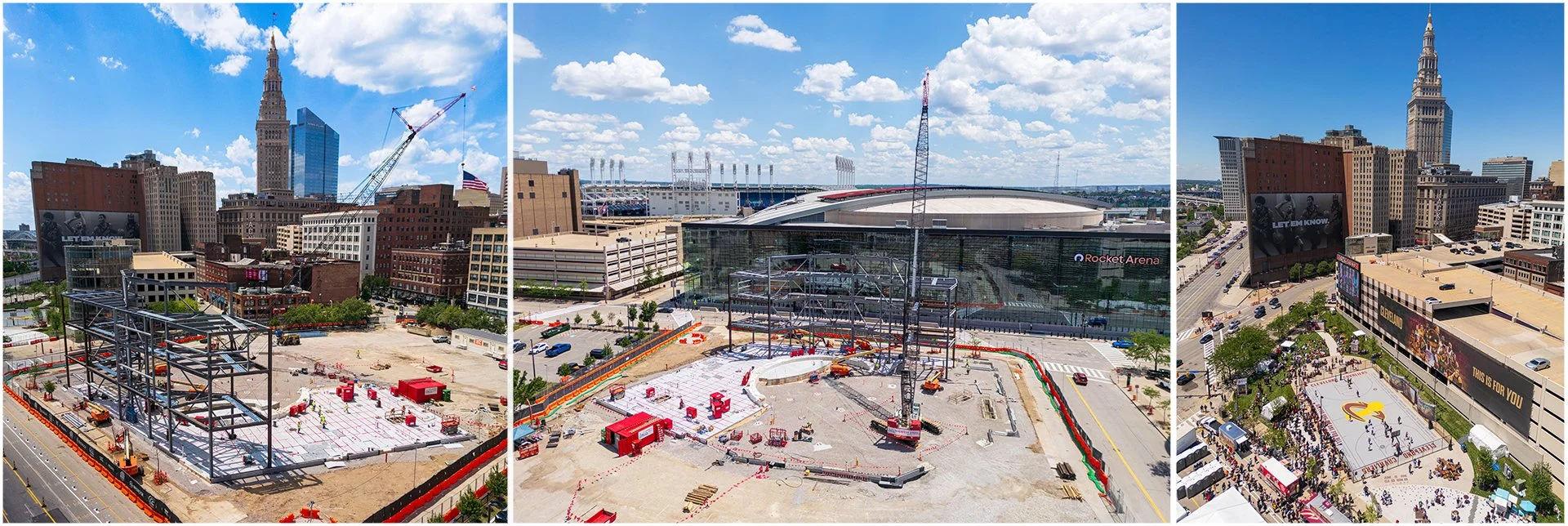
In April 2026, Bedrock, Cosm, and Rock Entertainment Group broke ground on Cosm Cleveland. The four-story, immersive entertainment venue will fill a three-acre parking crater across from Rocket Arena and anchor Bedrock’s “Rock Block” development along East 4th between Prospect and Huron. That broader development will connect the Gateway sports complex with Downtown’s surrounding entertainment hubs and complement the city’s effort to reconnect the core with our waterfronts.
While Cosm sits several blocks from the river, it reflects the same planning philosophy shaping the waterfront: thinking in networks rather than parcels, and treating every project as part of the connective tissue in a larger system.
Cosm and surrounding placemaking efforts have made the vision clear and tangible.
Just across from Cosm and Rocket Arena at the corner of Huron and Ontario, the reimagined Meet Me Here Plaza was unveiled in June, featuring a new park space and a Cavs-branded basketball court. Two-way bike lanes along Huron, added last year, connect the Plaza to a larger bike network that will soon include the Memorial Bridges Loop, separated bike and pedestrian paths along Huron and Ontario that will tie into existing bridge paths over the river. Construction is already underway.
The Memorial Bridges Loop will also help link Downtown and the broader bike and pedestrian network with a key connector between the Gateway District and the riverfront. Eagle Avenue, which once connected Ontario to the Scranton Peninsula, is being restored to carry automobile, bike, and pedestrian traffic to the Global Peak Performance Center, and to the water’s edge.
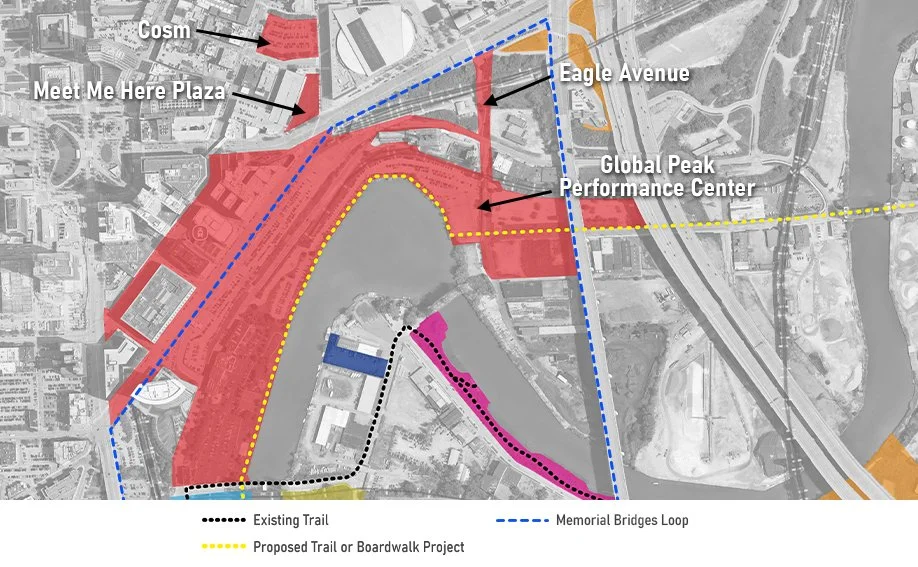
The Flats are no longer a collection of disjointed development sites. They’re being stitched together and back into the surrounding urban fabric, becoming a connected neighborhood where parks, housing, recreation, entertainment, employment, historic preservation, and public access improvements reinforce one another.
The timing is particularly significant.
As Cleveland’s riverfront is finally beginning to come together, the city’s century-long effort to reclaim the lakefront is also making tangible progress. Shore-to-Core-to-Shore, the North Coast Connector, the lakefront master plan (including the potential closure and repurposing of Burke Lakefront Airport), and riverfront investment all share the same objective: reconnecting Cleveland to the water that made the city possible.
None of this happened overnight.
Many of these projects have been in development for years, and some have been discussed for decades. They required land assembly, environmental cleanup, significant infrastructure improvements, public financing, patient private capital, and political leadership that extended beyond a single administration.
That kind of work rarely generates headlines, but it does generate lasting change.
There is a tendency to view public investment and private development as competing forces, but Cleveland’s riverfront tells a different story.
Public investment is helping unlock complicated sites that private development alone could not. Private development is adding residents, activity, and tax base. Parks and trails are creating connective tissue, environmental work is making public access possible, and historic preservation is giving old industrial assets a new life without stripping away their character. Long-term planning has ensured these projects reinforce one another instead of competing.
None of those pieces would have been enough on their own, and together, they are creating something much larger than any individual project.
The cities that thrive over the next generation will be the ones capable of aligning public investment, private capital, institutional leadership, and long-term planning around a shared vision for growth.
Cleveland has done that before.
Our parks, neighborhoods, bridges, public squares, and skyline weren't created through isolated investments. They emerged from generations of civic collaboration between government, philanthropy, business, and residents who believed the city was worth building.
That collaborative spirit built the Cleveland we inherited.
It’s also what will build the Cleveland we aspire to become.